Dan Montano: How Producers Lose Money From Royalties

About Dan Montano
Dan Montano is the co-founder of Royalty Masters, a royalty administration platform for music producers, and runs A1 Music Group, a management company that still handles around 25 legacy producers day to day. Alongside Daniel Cruz Hernandez, he also runs Producer Royalty, which offers one-off management services. In just two years, Royalty Masters has signed 140 catalogs and collected $8.5 million in royalties for some of the biggest producers in the world.
In this episode of Producer Talk, Esteban sits down with Dan Montano to delve into the challenges and strategies of succeeding in the music industry, and to uncover how producers lose money from royalties without even knowing it.
The Journey into Music
Dan's passion for music ignited in high school in Spring Hill, Florida, where he noticed the potential of his peers who were gaining popularity. Despite pursuing a ten-year career as a financial advisor, his love for music never faded. He began managing a rapper friend from his office but soon realized that working with producers offered a more fruitful path.
"Managing artists is a lot more difficult than working with music producers. Artists often take ages to finalize a song, while producers can quickly turn out beats!"
From Hobby to Business
From 2016, Dan managed producers as a hobby, putting money in without seeing a return. He toured the country hosting BeatStars meetups and met more than 5,000 producers along the way. After COVID, he got back in the game the same way he tells producers to: he sent a DM to DJ Ice, the man behind A1 Music Group, and paid for an hour of his time. That one consultation turned into three companies built together.
Building Relationships
One of the key takeaways from Dan's journey is the importance of building relationships over just sending work. When reaching out to others in the industry, he emphasizes a mindset of giving value first.
"When you DM someone, it's about building a relationship. Ask them what they need and how you can help."
Come Prepared
Before his first call with DJ Ice, Dan wrote a meeting doc covering everything he knew about his company, everything he had done himself, and a simple question: what do you need from me? The answer was clients. Fifteen minutes in, Dan ended the call, refused a refund, and brought back three clients within a month. He went on to become COO of the company.
The Art of Outreach
Dan highlights two distinct outreach methods: sending your work and building relationships. He suggests a consistent approach where producers reach out daily, but with a focus on relationship-building rather than immediate results.
"In sales, you have to be ready for rejection. Realize that 99% of the time, you won’t get the result you want. Just build that into your system."
For email outreach, less is more: short messages, sent every single day, to the same list of a hundred artists or producers. Then reach that same list on Instagram and Twitter, this time asking what you can do for them rather than what they can do for you.
Expanding Networks
Esteban and Dan discuss the often overlooked aspect of networking with not just artists, but also their managers, A&Rs, and even videographers. Videographers work with a ton of artists, which makes them some of the most slept-on connections a producer can have.
Online vs. In-Person
Meeting people in person still matters, but it isn't a requirement. Dan built his companies with partners he had never met, and some of the producers with the most placements on his roster live in Europe or Australia and have never met their collaborators. For Dan, there is a season for being outside and a season for being locked in.
Confidence and Mentorship
Dan also shares how his confidence grew through collaboration and mentorship. Early on, he paid a producer part-time to explain the basics to him, like what a loop was. He encourages producers to seek out partnerships that can bolster their confidence and provide valuable knowledge.
"Your confidence can come from others on your team. If you have someone who's been through the process, lean on their experience."
The Business Side
Today, Dan's A1 Music Group manages numerous legacy producers while also tackling sample clearance issues to ensure producers receive their due recognition and payment.
"We reach out to labels to ensure our guys are credited and compensated for their work."
The biggest growth, though, has come from Royalty Masters. Producers know BMI, ASCAP, SoundExchange and publishing, but most don't understand how master royalties are accounted for, and that's where the money goes missing.
How Producers Lose Money From Royalties
Jumping From Lawyer to Lawyer
The biggest mistake Dan sees is producers switching lawyers and managers every few months. Over a 10 or 20 year career, the paperwork ends up scattered and nobody can find the producer agreements. Producers who keep the same lawyer for decades have consistent terms that every label already knows, which makes negotiations, clearances and royalty collection much easier.
Trusting the Wrong People
Dan meets around 30 new producers a week, and at least once a week one of them has had their BMI, SoundExchange or master royalties go to a manager instead of them, sometimes for a decade. Half the time it's malice, half the time it's ignorance. Either way, his advice is to never put your paycheck in someone else's hands and to ask your manager where your money is.
Forgetting About Old Records
The bigger the catalog, the higher the chance money is missing. When a producer's career takes off, life moves fast and something always falls through the cracks, usually the master royalty. Dan's team once found $879,000 sitting for a producer across four albums with one artist. More recently, a producer with a 2012 Rick Ross album had $12,000 waiting at Universal from a song with only nine million Spotify streams, thanks to album sales from the pre-streaming days.
Understanding the Black Box
Publishing royalties and SoundExchange royalties have a black box period. SoundExchange, for example, only pays back three years: if you register five years late, the older money is redistributed to everyone else. Master royalties work differently. That money sits in an account with your name on it, waiting for you to claim it, no matter how old the record is.
Advice for New Producers
Dan's advice for producers without placements is to know your worth, but start somewhere. Sell your first beat for $50, then $75, then $100, and lock in with the artists who keep buying. Keep a day job and set aside a fixed budget for your passion, because most of the producers Dan started with quit music after burning through their finances. Esteban goes a step further: if you have no placements yet, give your beats away for free and treat them as a lead magnet.
Resources
For learning the business, Dan recommends "All You Need to Know About the Music Business" by Donald Passman, and "Think and Grow Rich" by Napoleon Hill for mindset.
Key Takeaways
- Give Before You Ask: Open every DM with what you can do for the other person.
- Outreach Is Sales: Expect rejection, keep messages short and reach out every day.
- Look Beyond Artists: Managers, A&Rs and videographers can all open doors.
- Stay Consistent: Keeping the same lawyer and manager keeps your paperwork and your royalties in order.
- Track Your Paycheck: Ask where your money is, and check old records for unclaimed master royalties.
Conclusion
As you navigate your own path in the music industry, remember that persistence and relationship-building are key. With ventures like Royalty Masters, Dan Montano shows that a focused approach, and a close eye on your royalties, can make all the difference.
For the full conversation and more insights from Dan Montano, be sure to check out the complete episode.
Frequently Asked Questions
How do producers lose money from royalties?
Most often through scattered paperwork from switching lawyers and managers, managers collecting money on their behalf, and master royalties from older records that nobody ever claims.
What is the royalty black box?
It's the pool of unclaimed royalties that gets redistributed after a set period. SoundExchange only pays back three years, and old publishing money is usually gone, but master royalties stay in the producer's account until claimed.
How should producers reach out to artists?
Send short emails with your work every day, and separately build relationships on social media by asking what the artist needs and how you can help.
How much should a new producer charge for beats?
Start low, around $50, and raise your price gradually while keeping your regular buyers. Consistent income beats holding out for big sales.
Esteban Candelario (00:01.282) Hey guys, what's up? Back with another episode. this is Producer Talk. My name is Esteban, your host. And if you're new here, this is the podcast where we sit down with producers and industry professionals to break down what's actually working in today's music business. Producer Talk is presented by Producer Fury, the number one CRM for producers. And today we have a special guest. Last guest we had a lawyer in the music industry, but I'm gonna let him introduce himself, man, really quick. Dan, just introduce yourself and then tell him, you know, what you do.
Dan Montano (00:26.299) What's up guys? I'm Dan Montano. I run a royalty administration company called Royalty Masters. and also A1 Music Group and Producer Royalty.
Esteban Candelario (00:36.95) Nice. I I always like to start on people's journeys like before they even become who they become. So like I guess tell us about yourself. How did you even get into this path? Like what was the beginning of the source for you?
Dan Montano (00:48.901) Yeah, for me it's a little different. For like my love for music, it started when I was in high school. we were
To high school in Spring Hill, Florida. I'm from New York originally, and we had this thing which most high schools probably did where like the cool kids would get up on the on the desks in the lunchroom and like stand up and like clap and dance and like everybody like all the attention went on them. And this is like probably 2012. And I was selling candy out of my backpack because I've always been into you know making money and doing that. So like I knew those guys and I was like, Bro, these guys are like normal guys, but everybody sweats them, you know. And this is around the time like DJ Khaled was really popular, and I was like, Bro, like if these guys
Had some like management and they had some some direction, like they could go far because people's eyes are on them when they're walking around the hallway. Like, everyone thinks, like, this guy dances so well, or you know, he raps, or whatever it was. So that's kind of where like the thought bubble popped when I was in high school, and then fast forward, you know, I I became a financial advisor and I was in sales for 10 years. I started when I was 19, and you know, I I really never lost that passion for just music and entertainment as a whole, and then I ended up meeting.
meeting a buddy of mine who's a lifelong friend now. I just went to his wedding
last weekend, the weekend before that, and he was in my in my company. It was you know, I was a financial advisor. He was an insurance agent. And basically he would walk around the office spitting J. Cole bars and I was like, Man, like you got you got some talent, bro. I like, have you ever rapped before? I went to the studio. He's like, Yeah, back when I was younger. So similar story to me. He had a love for music and then he got into the corporate world and I was like, Bro, I'm gonna manage you. Like we're gonna go to the studio. So we did that and I worked with him for a few years. But like I said, we're lifelong friends. He did
Esteban Candelario (02:10.942) Dan Montano (02:29.763) necessarily do that anymore, but he has a podcast now actually as well. And long story short, I realized quickly that managing artists specifically is a lot more difficult than working with music producers. The guys that I met at the studio that were producing, they were just popping off microwave beats, you know, selling them and getting paid. Whereas artists would sit there and ponder over the lyrics of a song for days and weeks and months and then they're spending all this money in recording time and, you know, engineering costs and then then
The song would get done and they're I don't want to put it out because yeah, I don't like it. And then I'm like, okay, that's not profitable. Can't do that. So long story short, I was basically as a hobby managing music producers since 2016. And that wasn't profitable for many, many years. It was just a hobby. It was like going golfing or anything else, playing paintball, right? I was just putting putting my money into it and not really seeing the return. And then finally I locked in with a couple of my partners. the way that I did it was I just hopped in their DM. I I knew that.
I could bring a lot of value to the music community. I just didn't know how yet. So I was running around doing Beat Stars tours. If anybody recalls back in the day, Beat Stars used to do like the in-person tours. I was kind of going around meeting a lot of different people and kind of just like checking the lay of the land back in like 2017-2018. And then I, after COVID hit, took a little bit of a break from the studio. And then how I got back in, as I mentioned, I I hopped in a DM of a couple of guys that seemed that they knew what they were doing and said, Hey, I'll pay you for a concert.
consultation. So I put my money where my mouth is and just built the relationship with these guys. And we've built two companies since and we have three companies that we all run together. And it's been great.
Esteban Candelario (04:10.936) crazy all from all from one DM or a couple DMs and I I think it's so funny because I always tell producers I mean that's the whole thing about like producer theory itself is like finding artists, DMing them. And I think maybe you can help them with this, but I actually had 'cause we have a Discord community and I had somebody DM me and he was like, Hey man, I keep I keep DMing artists but none of them are answering me. Or like none of them are getting back to me. Or they just they just I send them beats after they answer me and and I just never hear from them. I just ghost them.
So like in your your experience, you actually reached out to somebody, paid somebody, and you still became like a business partner with them and started a business, which is even harder to do because you paid them for something else totally different. So like, what's your what's your idea when you go into somebody's DMs, right? And like how do you like even bring value?
Dan Montano (04:58.555) Well, I think there's two different ways that producers reach out to prospective artists or or co-producers. I think one is when you're sending your work. And I think that's a completely different outreach method that has to have you have to use a different side of the brain when you're like sending email outreach with your MP3s or, you know, whatever you might be doing with your loops. And then the other outreach is when you're building relationships. So like when you DM somebody, I feel like that's more of the building relationship moment and they'll see your name be like, this guy's been emailing me for three
years so I guess we could start with the email outreach the you know in anything in sales you just have to be ready for the rejection and realize that 99% of the time you're not going to get the result that you want so when it comes to the email outreach I feel like less is more sending less in an email very short and sweet and just doing it every single day that will get you
like a lottery ticket at least to the you know, like a ticket to the game to you have a chance of somebody opening that email and not expecting results. Just build that into your system. I have these hundred producers or these hundred artists that I send beats to every single day. And I just built that into my flow. And you know, that's just one side of it. But then that same hundred people you should be reaching out to on Instagram and Twitter, where however you can get a hold of them and doing the relationship building part, which is not what can you do for me.
Esteban Candelario (05:54.243) Huh.
Dan Montano (06:21.359) is what can I do for you? So what kind of sounds are you looking for? You know what what what can I do to bring you value and figuring out a way to kind of phrase it so that you don't so that you're not taking. You know, Gary V has like the whole jab jab jab right hook, right? It's like give, give, give, then ask. And that's that's where I think a lot of producers get it twisted. They get in the DM and they want to send their work right away, but then it's like they're asking for something. But it's more about like what can you do for 808 mafia or for Southside? Like what could you do for for
it on the track and then from there you know you guys build a relationship
Esteban Candelario (06:55.266) Yeah, yeah, no, I totally agree. And you know what? I also think it like I think messaging the right person makes a big difference. Cause I know you mentioned like managing artists, and managing artists are difficult. Like the artists are just artists, like you know. And I think producers, because that that to reference that person I was talking about earlier, producers think so much about the artists and they think that the artist is the only person they can reach out to. And I had messaged him, I was like, okay, reach out to artists, but also reach out to the ARs, reach out to their managers.
Or especially if you're reaching out to a bigger artist, reach out to smaller artists and their network. It's so easy. Just click on their following and you can see who they follow. You know, or if you really, really want to get creative, reach out to videographers and tell them you can make background music for them, background beats, or you know, whatever it is. Because videographers are the most slept on as far as like plugs for you know networking and putting your music out there, especially for for artists, because they work with a ton of artists and add videos and stuff like that. So yeah.
Dan Montano (07:49.829) Yeah, I agree completely. Yeah.
Esteban Candelario (07:52.569) So it's like, you know, like sometimes, and this is kind of like ironic, but sometimes the artist isn't the best person to reach out to. He's the best person to start with and then figure out the rest. So I mean, when it when it comes to, you know, you mentioned like a lottery ticket, it really is, especially with code emailing and code DMing, you know, have you ever been in a situation where you were like, I'm tired of this and I don't know if this is actually working for me and got to a point where, you know, you quit or you just always like find yourself like pushing yourself and and and going forward.
Dan Montano (08:22.951) I I've been very blessed to have like this stick tuitiveness that it just lives within me that I just I always want more and I push myself to the limit, probably too much so. I got married three years ago and my wife reminds me all the time that I need to relax a little bit 'cause I just tend to just push myself too much and in sales that really helped me excel. I s my first job was at McDonald's and I remember I would try hard to make the sandwich wrap, but I was in the back, you know, making the
Esteban Candelario (08:35.18) huh.
Esteban Candelario (08:47.038) Yeah.
Esteban Candelario (08:52.64) Yeah.
Dan Montano (08:52.945) food so I would try to make the sandwich wrap we had a timer and I would try to push them out quicker than anybody else you know and that for me was the biggest thing was I I wanted to to be you know the best at everything that I did so like transitioning that into sales very similarly it it it's just it always is how my brain worked but I found that most people that especially music producers they don't know that they're in sales they forget that aspect of it and to what you just mentioned earlier you know you have to be willing to say okay I want to get to this artist but to get there
Esteban Candelario (09:00.483) Yeah.
Dan Montano (09:23.065) I'm gonna go through, not the producer, maybe not even the engineer that I know works with that guy, but you just said videographer. Like that's outside the box thinking that most people aren't willing to go that extra mile to to even think that hard, but let alone then hit up all four of the people on that list and then do that a hundred times for a hundred different artists that they're trying to work with.
Esteban Candelario (09:43.639) Yeah, a hundred percent. And also you gotta be ready to do that for three years and may potentially never seeing anything or having a bunch of small wins to a compounds and then you actually get a crazy placement or something like that. but yeah, man. So I know you were talking about how you got into it and then how you met your mentors and then you know how you guys became business partners. So I guess I wanna pick it up from like that angle. Like what did you begin doing when you became business partners with your mentors? And then what did it like turn into?
Dan Montano (10:13.637) That's a good question. the early on relationship was a hundred percent what can I do for them and just me bringing value to the table. So like coming correct to a meeting like that is super important, especially when I met DJ Ice, who's the guy that runs A1 Music Group. I set the call with him, paid him the hundred bucks or whatever it was for an hour of his time, which most people they would just never do that. Like, you'll pay for a Netflix subscription and all this extra stuff, but like for whatever reason
Esteban Candelario (10:39.138) Uh-huh.
Dan Montano (10:43.661) You won't pay another man for his time, which is weird to me. But I've always seen a lot of value in that. And I know that if I get someone's time, I'm either gonna learn something from them to get that hundred back, or I'm gonna build a partnership like what we did. So before that meeting, and this is like so crucial, when you're gonna pick somebody's brain or go into something, you want to build a doc. And we didn't have AI back then. So I went on Google Docs, took a template, and it was just like a meeting notes template. And I wrote out everything I knew about his company, I wrote out everything that I've done in the past, and then actually.
Steps on like what do you need from me? Like, what can I do to help what you're doing? And at the end of the day, like most people's response is gonna be give me clients or give me, you know, opportunities or AR might be to whatever you know, whoever you're reaching out to might be different. And for him, it was just let's find some clients and work together. So I ended up scheduling another hour session after that to ask a couple more questions. And after 15 minutes of talking to him, I was like, Bro, I'm good. You've given me the a lifetime worth of sauce. I'm gonna go get you three clients before we talk again. He's like, nah, bro.
Esteban Candelario (11:39.074) Mm-hmm.
Dan Montano (11:43.414) It's only been 15 minutes. I'll send you 100 back. I'm like, no, you're good. I promise. I got three clients come within a month. So I just went out and I just started hitting up producers that were in the niche that this gentleman was working in, which was sample clearances. And then we crushed it. And then from there, it was just a natural progression of me becoming the COO of his company and then me pivoting to starting another entity as the CEO and having him as my co-founder.
Esteban Candelario (12:09.742) That's crazy. That's hilarious. How how were you already so confident within fifteen minutes? Like did you was it was it already something you were so familiar with and it was so easy? Or you just kind of like was confident enough in you just because you believed in yourself? Like what how do you even go ahead?
Dan Montano (12:23.427) It's it's actually interesting at the at because for me, I you mentioned earlier like knowing what you're good at and what you're not good at and like knowing your like your the things that make you tick. And then I had a team around me at the time. I hired a producer, I was paying him like a part-time wage to kind of consult for me. So what I was doing was I was taking the information I was getting from DJ Ice and then going back and reviewing that with this kid and I was like, yo, what does what is looper man? I was like, what is a loop, right?
Esteban Candelario (12:30.322) mm-hmm.
Esteban Candelario (12:52.194) Mm.
Dan Montano (12:53.361) I was like, I didn't know, like, you know, I'm in the studio and these guys are making beats. I didn't know that there was a world where people make a sample, send it to a beat maker, and then he throws drums on it. I did not understand that for like three years of doing this. And then, like, so I I had the confidence through someone else. And I think that that's where people sometimes forget it. Your confidence, you can steal from others that are on your team, people that you know. So, like, if you have a partner of yours, if you're a producer that has already gotten a major placement before, you should have the confidence that when you
Esteban Candelario (13:05.464) Mm-hmm.
Dan Montano (13:23.261) land your first major placement that it's gonna go well because as soon as you get that email from Warner or Sony or Universal, you're gonna hit up your partner be like, yo, what is this process like? How does this work? And he's gonna walk you through it. So you don't have to actually know anything. You just have to know the people around you that that know the answer.
Esteban Candelario (13:40.429) Yeah, yeah, no, that's a good point. there's this quote. I wish it was I wish I remember it, but essentially it's saying like people are like books, you know, books are full of information and education and you can gather that from like people themselves, especially with people who are who have a understanding of something really niche, even if it's something as simple as loops, you know. that that's crazy. So I guess go go a little bit deeper on the business side of things. So like what do you and and I think you said Calm DJ Ice do exactly for producers and you know, you know, and how does that whole process work for you guys?
Dan Montano (14:09.957) Yeah, so we run A1 Music Group, which is a traditional management company. and then, you know, we have probably about twenty-five legacy producers that we still manage day to day. we take on some sample clearance stuff still, 'cause that's the bread and butter of how we started. So it keeps us humble. so when producers get their beats or loops stolen or they don't get credited on stuff, kind of we go out and like like Robin Hood, if you will, we reach out to the label or reach out to the co-producers and we're like, hey, our guy hasn't been credited here, and we run through the whole sample.
Sample process start to finish, we get them a sample clearance fee or in advance, along with equal publishing splits and then master splits on that. And then my partner Daniel Cruz and I, we have producer royalty, which has a podcast as well and is more so focused on management services. So it's kind of like a playoff of what A1 was doing, where it's traditional management company, we're signing management clients as producers, whereas producer royalty we kind of do one-off management services. and then the the big pull.
Lately has been Royalty Masters, which is a royalty administration platform where we work with the biggest producers in the world. We've signed 140 catalogs and we've done eight and a half million dollars in royalty collections just in two years since we started it. So it's me, DJ Ice, and Daniel. So we partnered on that. We're all co-founders. and it's been it's been a crazy whirlwind in the way that we've been growing, just because music producers, they they they know BMI ASCAP, they know sound exchange, they know publishing, but it's
Esteban Candelario (15:24.814) Crazy.
Esteban Candelario (15:39.128) Mm-hmm.
Dan Montano (15:39.901) don't understand master royalties and how those royalties are accounted and it's not easy and I don't blame them for not wanting to understand because it's a different side of the brain completely.
Esteban Candelario (15:49.903) Mm-hmm. Yeah, I was talking to Daniel before you when I'm re recording an episode, it'll come out before this. But I just think it's crazy. Eight million dollars is probably like a bucket in this in the system compared to what like what's actually out there, just sitting out there from legacy producers or current producer. You know what I'm saying? It's just crazy to think that that seven figure number or yes, seven figure number is just like the smallest amount you can imagine. It's probably more like eight, nine, ten figures out there somewhere in the world that these labels have. It's crazy.
Dan Montano (16:15.534) Easily.
Esteban Candelario (16:19.47) I was gonna ask a question. What was I thinking? I was gonna ask. So I mean, a lot of producers going into this, like, what's the biggest mistake that they're making that would that if they could change would prevent them from like losing these opportunities, like master royalties and publishing and whatever else that you guys help them with?
Dan Montano (16:37.465) jumping from lawyer to lawyer and manager to manager. People think that other people are their problem. They're their own problem. And when when you jump from manager to manager, from lawyer to lawyer over a 10 or 20 year career, nobody knows what the hell's going on. The paperwork's all over the place. There was never any structure to your business. Whereas guys we meet that have had the same lawyer for 20 years, everyone in the industry knows when that lawyer and that producer on an email thread, here are his terms. It's been that way for two decades.
So, like Justin Bieber's lawyer, Drake's lawyer, Lil Wayne's lawyer, when they get an email thread with this producer that's been with the same lawyer for 20 years, they already know what to expect. They know what the terms are gonna be. It it helps the negotiation, it helps the clearance process. And then what it helps is an admin company like us, when we pick that client up and I say, Okay, do you have your producer agreements from the record you did in, you know, on Biggie Small's Life After Death album? He's like, Yeah, my lawyer has it. And why does his lawyer have it? Because he's had the same lawyer for 20 years.
20 years. But if he didn't have the same lawyer and he jumped every six months, like so many guys do, then they're like, yeah, no, I don't have my agreements. You'll have to talk to this guy. And then this guy's like, no, that was before me. You gotta talk to this girl. no, I haven't only been working with him for 10 years. yeah. And really what it does is it just messes up the consistency. So, like the short answer to your question is producers need consistency in their life, they need to have a schedule.
and a structure and when they're jumping ship to different managers or different lawyers expecting that to be the thing that's gonna help them, it really ends up hurting them in the long run just because they're not able to stay focused on creative. They're worried too much about the business.
Esteban Candelario (18:21.454) Do you know why they jump ship a lot and jump in between people a lot? Yeah.
Dan Montano (18:24.485) Just 'cause we're human.
You know, it's it's no different than before, you know. I don't know if you're married, but you know, it's no different than dating. You know, it's like there's always something better, right? And being married for three years, I could tell you like you end up realizing I'm thirty two and I got married when I was twenty eight, twenty-nine. You end up realizing in life that like just like you know, you look at somebody's car, like there's always something better, right? You're there's never gonna be, you know, like I have the most money or I have the best hair or I have the nicest chain. Like someone's always
Esteban Candelario (18:29.964) Mm-hmm. Mm-hmm.
Mm-hmm.
Dan Montano (18:56.009) gonna have something better. So like you when you're dating, you can't look at it from the perspective of like, you know, this is the the best looking female I've ever been with, or this is the nicest girl I've ever been with. Like there's so many different qualities that make up a good woman. And when you find one that's morally sound, that has faith in the Lord and you know all the different characters that you're looking for, like that's the person you're gonna spend the rest of your life with. And you're not gonna be thinking about it from the perspective of is there something out there better? Because then if that's the case you'd never get married. Same thing for producers, you know, you don't
Esteban Candelario (18:57.934) Mm-hmm.
Dan Montano (19:26.019) want to be thinking like is there a better manager out there? Because yes, the answer is always yes. And if you keep trying to find the better manager, side quest here, my my partner, who I won't name his name, he he's like on every AI tool. Every new AI tool that jumps out, he's like on that next tool. And same concept there, like we didn't have any of this a year ago. There was no Clawed Bot, there was no clawed code, like none of us were vibe coding, like we had none of that and we were still very successful. So like
Esteban Candelario (19:35.55) Mm-hmm.
Esteban Candelario (19:41.198) Mm-hmm.
Dan Montano (19:56.002) Find an AI that works for you and then like run that play for a year. And then if you want to like look into the next cool thing, that's that's great. But like everybody, we're human and we like shiny things, so we're looking for like the next best. And then it's a dopamine hit. When you transition, it's a dopamine hit. It's like a small business owner. I know so many people, including myself, who have started 10-15 different companies, and you get addicted to starting them. You get addicted to opening the LLC, you get addicted to opening the bank account and feeling that dopamine hit, the business card.
The logo, the the still shot picture, and you've never even gotten a client. You've never made any money. So I'm gonna go off a tangent on that, but it
Esteban Candelario (20:33.154) No, you're good. No, you're right, you're right. I don't know if you like, I don't know if anybody who's watching this watches Alex Ramosy, basically a a business guru, and he says focus isn't about adding, it's about subtracting. Like literally just taking away and having the the least you can have to like just be focused on whatever you're doing. And that makes sense, especially in this industry where people just wanna get on. Like in this industry, I feel like that's all it's about. People just wanna get on and they'll do whatever it takes to get on. So if they see somebody who might offer them more, whether it's a lawyer or a manager, of course they're gonna jump.
jump jump off the ship they're on and then swim to shore just to you know what I'm saying look for another ship and then swim back swim to that ship and ask them, hey, can you help me because I'm drowning and then boom. That makes sense. No, that that doesn't make a lot of sense for you personally. because I I imagine most of the producers you work with are already established, already have managers, or already have like, you know, like a placements and things like that. It have you ever been in a situation where you're working with a producer or a looper who's brand who's brand new, who's just got
got placements just out of pure luck because he's just been grinding and has no management or anything like that. And if so, like what is what does that journey look like trying to help that producer navigate?
Dan Montano (21:41.756) Yeah.
So when I got started, we we never worked with any producer for like three years that had a major placement. Like my guys that I was working with were in the studio selling beats hand to hand combat YouTube channel, BeatStar store. Me and my partner who who passed away recently, a couple years back, his name is Knowledge. We used to go around and drive from city to city to go to all these Beat Stars meetups. So like I've met probably 5,000 producers or more all over my time doing this that were in that predicament.
didn't have a manager, never got a major placement. So that's how I got started. And you know, the same way there, it's like understanding your worth, but also being realistic and trying to turn your passion into your day job. And a lot of the guys that we met over the years were doing something else for a living to make pay their bills, but they had a passion for music. And those same guys wouldn't sell a beat for $50 because they thought, well, I'm worth more than that, right? But if if you're not making money selling beats,
and someone offers you 50 bucks, I would take it because you have a thousand beats. So, you know, I wouldn't get, I want to make it a habit, but you know, the long and short of it is like know your worth, but like you have to start somewhere. So sell your first one for 50 and then sell it for 75 and then 100 and then naturally let your price progress but keep that cat that constant flow. That guy that bought it for 50, like lock in with him and sell him $50 beats for the rest of his career as an artist because that's consistent income for you. And he's in the studio every Saturday.
and he'll buy a beat from you every week and then like a scale it from there. But sometimes we get short-sighted as as human beings and we like to think that like we're better than that and like my beats are on Beat Stars for $500 for exclusive. I wouldn't sell this to you for $50, but like, you know, you gotta think more long term. And just like what I did and even though I'm not on the creative side, you know, I had a day job for 12 years. And for six of those years I was trying to make music work and it didn't. I'd ever made any money. I was spending money.
Dan Montano (23:42.074) And then eventually what happens is the pendulum will swing and your
your hobby or your passion will become your gig as long as you put the time in and you've scaled it properly. So like I think a lot of producers they jump off the porch too quick and they they they go right into it without having a backup plan, without having a day job to support them, which could work, but I think that's more like a lottery ticket. Like I think that sometimes that that it's good to do that, to jump in head first without a plan B in certain aspects in life. But with music producing specifically, I have seen that crash and burn more so than not because a lot
lot of the guys that I know from when I first started doing this, in fact, ninety-nine percent of the people that I was working with when I first started doing this are no longer doing music because they put way too much time into their passion, less time into building a foundation for themselves financially. And then unfortunately the creative just falls out of them because it's like they're so stressed about finances and then they just stop completely.
Esteban Candelario (24:42.488) Yeah, no, a hundred percent. I I I've been there in terms of like, you know, starting something with no like safety net and then completely failing and then having zero dollars and then having to start over again and then it took me a while, maybe to like I got to twenty five. Maybe my brain like fully developed or something, but I was I realized like, okay, I gotta have something, bro. Like I can't just like you know but the idea is really nice to be successful in whatever you're doing without working a job, but that's rare, you know, that's rare in a few cases. And I don't come from a rich family and I'm most people don't come from, you know
extra resources that help support them. So it's like picking that up and realizing that you're gonna have to work twice as hard in the beginning. And I'll go a step further because you mentioned like, you know, I it was an example, but you mentioned like selling your beat for fifty bucks. Like I'll go step further and say like especially if you're somebody who has no placements, who's starting from zero or has been doing it for a long time and hasn't been able to build a following, no placements, just hasn't hasn't been able to get any opportunities, you should be giving your baits beats away for free.
You should be giving your beats away to as many people as humanly possible. You want to give like I I guess what producers don't understand is like what they're what they have is a lead magnet and it attracts some people. But if you reach out to people and you offer to offer it to them for free, like you know, eventually it's a numbers game at the end of the day. And also I think reaching out to as many people and building a strong network has never been easier than it it is currently. Like you have Instagram, you have Twitter, you have email.
the only thing I'd say is like building a network faster has been easier, but building relationships has been harder because it's been so easy to build a network. So, what do you I mean, what do you think about like producers who who want to build relationships like in this industry? You know, I think offering a beat is like easier said than done 'cause everybody's offering beats to these artists and stuff like that. I guess from your opinion, what from what you've seen from successful producers, like how are they building relationships and
Dan Montano (26:16.887) Mm-hmm.
Esteban Candelario (26:37.442) Developing those.
Dan Montano (26:38.949) Yeah, I think that and this is controversial and I probably shouldn't be talking on this because I'm not a creative, but I think what would work and I'm it's this conceptual here, I don't know if it would work. but I think somebody should offer to help creatively as a work for hire for free. Give their give their work away like you just mentioned for free. Put elements on a beat. If you know how to mix and master, like mix and master records or or beats for another producer, just offer your services for free. But know when
When enough is enough, and when you need to start asking for money, and that doesn't come naturally for some people. So you find somebody like myself or you who has experience asking people for money, and then you'd be like, Yo, here's a situation. What do you think about this? I've been working with this guy for three years, I've never gotten paid. He doesn't give me any opportunities outside of the things he sends me to work on for him. And I and then, like, me or you would tell him, like, yo, either one, you need to start asking for money, or two, you need to stop working with him because now he's taking
Esteban Candelario (27:11.319) Uh-huh.
Dan Montano (27:38.756) Taking advantage of you. But most human beings are good people. And after like a year of working with somebody for quote unquote free, eventually they're gonna get to the point where they're like gonna give you some real opportunity and they're gonna start breaking bread with you. So I but I think too many of us, you get caught in like, that's my dude, that's my homie, we're in that relationship, and I don't want to ask for anything, I don't want to ruin it. But I'm like, bro, what is the relationship? He's taking advantage of you. So
Esteban Candelario (28:02.838) Yeah, yeah. And I some things are more important than money, like opportunities. If that person has provided so many opportunities, like, hey, I got a homie, link up with him, and that's been an opportunity that's turned you into a great financial situation, then sometimes, you know, that relationship is more focused on that than it is about the money. But up to what you're saying too, like it works both ways. Knowing when, I think is the most important part. And I think the best way to know when is when people actually start reaching out to you.
Like, you know, in the beginning, it's the other way around. You're you're pouring, I guess, like a a water into to a bucket. You're pouring all every single drop into that bucket, which is you reaching out to people. But the moment you start getting referrals from, you know, other artists like, Hey, such and such said you made this beat, I was really rocking with it, want to know, like, you know, I want to tap in with you. If somebody wants to tap in with you, it's way easier to charge them because they've listened to your stuff, they like your stuff.
And I don't think people realize like it takes a lot of energy for people to actually reach out to you and ask you for something. So I think until you get to that spot, especially in music or like as a producer, you you're you may not be charging for a while. Like you might you might not you might just be putting in that free work for for a minute. but I mean, for you personally, I cause I know you mentioned you were like putting more money into I don't know if it's the business or the music side,
How long did you tell yourself you were gonna invest in it before you're like, you know what, if it takes X amount of years for me to invest and I don't receive anything back, I'ma quit? Or would you were you investing regardless? Like you didn't even have that thought in mind.
Dan Montano (29:38.6) From day one, I was going to do it until it worked or until I went broke. And for a while I was broke because every time I had money, we would travel to another city. I would break bread with a producer. I mean, we were earlier on we were paying producers to make beats by the hundreds. And then we were going to studios and selling those beats to artists because the producers couldn't sell the beats. So like I'll be like, yo, I'll give you fifty bucks for this fifty pack and then like they're mine now. Or no, I'm sorry, five hundred bucks for this fifty pack of beats, and now those beats are mine.
And I'm gonna go try to sell them. So at least now you have 500 bucks and now I can go try to flip these. So like that doesn't work all the time. Like I have hundreds of beats in my Dropbox still to this day that I bought, spent thousands of dollars on that I never sold, you know, because after a couple months, that sound is just not the move anymore, right? So for me, I I always knew like this is going to work. And the people that were in my life at the time, there was like one or two people that would be like, yo, you're gonna you're gonna figure this out, but everybody else still to this day thinks I'm crazy for leaving my finance job.
And and being in the music industry, they just they don't see it for themselves, and a lot of times they project on you because they want to do something else with their life, whatever it might be. So, you know, for me it's just about knowing like this is what I want to accomplish, and I'm gonna put my money where my mouth is for as long as I can. But the key was I I say bankrupt, but what I'm what I mean is there was always a set amount of my finances that I knew like I'm gonna spend this on my passion, and that's all I ever spent. I never went over that, but I was willing.
To do that forever as long as I still enjoyed doing it, and that I think is inherently the difference. And another piece of that is I know when to hold them and when to fold them, and I I ask God for guidance often on like what it is I should be doing, and I ask for open or closed doors, and specifically with with music. Right before COVID hit, there was a scenario that I did not ask for where I was asked to step away from a music studio and to give my key back, and it wasn't anything that I had done.
Done particularly. It was just like differences in opinion at the moment. And I was relatively working there for free to the point we just mentioned. I wasn't getting a salary. I was just in there like taking phone calls, booking meetings for them. So I had access to the artist so I could sell the beats or do consultations, whatever. And I was asked to step away at that time. And it was a month before COVID hit. So like, you know, God closed that door for me. I didn't know COVID was coming. I was devastated. But what it allowed me to do was to take a break from the music scene for
Dan Montano (32:08.239) about 18 months I never stepped foot into a studio again and I locked in on my day job and I crushed it because I was super zoned in but every day that went by I knew that there would be a reckoning and I'd come back one day and I'd come back better than I was when I left and I think too many people that 18 month period would have killed their spirit and they would have forgotten that that that light in them that passion but I just was like God when the time is right I'll know and you'll open a door and I'll get back in and then that's exactly how it happened and I started
the producer collective and then I hit up DJ Ice sent a DM sent the 50 bucks or 100 bucks whatever it is I paid him for his time and then from there you know I was able to quit my day job two years ago and it's been crazy.
Esteban Candelario (32:51.31) Crazy. And I mean that's the most important thing. Like the timing is more important than when you want it. I think a lot of time, like not even just producers or artists, like people in general, they expect it when they want it. But ninety-nine percent of the time it never happens when you do. And if you hear stories about that, just know that they're the top zero zero zero point zero zero zero one percent of people that are beyond like even winning the lottery of of life. Like you know what I mean?
And also I think life has a funny way of preparing you for, you know, the right moment. Like it sounds like it would you were being prepared for that moment until it actually happened. and I I'm a big b a big proponent or believer in that as well. Like knowing one, knowing when it's right for you, and then also knowing when life knows when it's right for you as well. is there I know you mentioned I was gonna ask you this, but you were just saying so many interesting things I kinda forgot.
So you mentioned something about Beat Stars and going to different cities and networking with producers. I'm really interested in that. Like, is that something they still do? And like what exactly was it? Was it just like them hosting events around the country?
Dan Montano (33:57.564) Yeah, they were called Beat Stars meetups and it was twenty sixteen, twenty seventeen. They had like thirty thousand followers on Instagram at the time. it was very new in the life cycle. And yeah, it was just a Beat Stars meetup and basically the vibe was they would pick like a mentor in each city and then we would kind of go to the city as the mentor in some cases and we would kind of host or that was called a host. It was the we would host the meetup. So we would drive to these different cities, we'd we'd schedule
Esteban Candelario (34:00.984) Yeah.
Dan Montano (34:27.507) them out, you know, based on what would make sense for us. And we would drive to all these different cities and basically the vibe was you'd go in there and it was like kind of like a cook up session, meets like a consultative kind of thing. Super low key though. It wasn't very like structured. At least early on when we were when we were doing it, it was just like everyone gets together, we take a group picture and like we vibe out. We'd host them at recording studios or, you know, Beat Stars would get like I think there was one at like
in Nashville, I forget where it was. It wasn't a studio, but it was a like a a music school, I think, SAE or something like that. We did that in Miami as well. So there was you know, they would put it on at different places like that. And it was just a way for the producer community to get connected. and the same thing that got us into that, we didn't ask BeatStars for anything. So we were putting our own money up to rent a car. We got we funny story, we got carjacked in St. Louis. So like somebody came to the Beatstars meetup, stole our key and took our car and we were stranded in, you know, BeatStars took really good care of us and
Esteban Candelario (35:16.798) It's crazy.
Dan Montano (35:23.625) And put us up in a hotel, made sure we were good at that moment. But, you know, we were we were out there and like really putting our best foot forward to try to help the producer community with anything that we could, teach them how to sell beats, help them understand the BeatStarts platform and you know what Beat Starts was becoming, which they didn't even have a publishing admin back then. Like it was so early in their life cycle. So it's cool to see the growth and they're they're a great team.
Esteban Candelario (35:27.128) That's hilarious.
Esteban Candelario (35:46.873) Crazy, I had I had no idea they even like did live events like that. now I kind of want to look into it. Hopefully they still do those because I would definitely go to one of those. But it sounds like you were basically on tour, honestly, essentially, and then just like meeting people. and I think the biggest misconception is the power of meeting people in person versus just being online. So, like, to you, have you ever had a scenario where, like, you know, you build a network online and then you've met that person in person and you realize like
the value of relationship goes up dramatically 'cause building the connection in person is totally different.
Dan Montano (36:20.485) Yeah, it's definitely it's definitely different. And I think there's a time and place for each type of relationship. some of our producers that get the most placements have never met, I mean they're they're they're in in Europe or in Australia and they've never met any of their co-producers or any of the artists and they crank out placements. So there is a world though where that guy gets a visa, comes to the US, lives here for a few years, and turns up, right? There's a season for that. But I I don't want people that that don't have that opportunity right now.
Esteban Candelario (36:26.947) Mm-hmm.
Dan Montano (36:50.489) To think that all all is lost because I met my business partners and locked in with them and built companies before I ever met them in person. I sent a DM, had a call like this. We never met in person. So you are able to do a lot of relationship building over the internet. And like even now, we have 140 catalogs, right? I mean, I'm I don't think I've met any of these guys in person. My business partners have. They go outside a lot more. Like I'm locked in in the office, I don't go out much, you know. But like there's a season for that because, like I said.
Esteban Candelario (36:58.936) Crazy.
Dan Montano (37:20.329) Said 2016, I was outside, bro, like for nine months out of the year, and you know, in studios and doing different stuff with with beat stars and various opportunities. So that was the season of my life where I was starting to understand and learn what you know that next layer was going to look like. But now it's kind of flipped, and now I'm I'm more so locked in and I don't go to the Grammy parties or you know, I don't get involved in all that because I know my lane and the season of life that I'm in.
Esteban Candelario (37:48.941) Yeah, damn, that's important. Season of life is a crazy way to to look at it. And I think in the beginning, that is your season. Your season is just being outside, like talking to as many people as you can, making as many placements or whatever it is that you need to do. and to your credit, you're totally right. Because like, you know, the if whoever's watching this don't know doesn't know, I'm not the creator, producer, furry. Somebody named Fabian is, and that's exactly how we met. He's in Europe right now and I'm in the US, but we still build a relationship online.
So it could work both ways, a hundred percent. I just feel like sometimes the the value of meeting in people in person has actually gone up because we're s we're on our phones so much or on social media so much. So like it's funny, we see people more, but we see them less in real time, which is like like mind boggling, you know what I mean? but yeah, man. As as far as anything in the music industry in terms of obviously what you deal with and what you're comfortable talking about.
Dan Montano (38:35.895) Mm.
Esteban Candelario (38:47.754) Is there any situation that you've seen that blew your mind when you were like, I don't even know how this even happened? Or like I don't even know how this producer was able to go this long without receiving his royalties or anything like that?
Dan Montano (39:01.455) Yeah, I mean
We see more often than we would like to admit, producers trusting managers that don't actually understand the music business. And fifty percent of the time it's malice and they're they're trying to steal somebody's money, and fifty percent of the time it's ignorance and they don't understand what's happening and they're not they don't mean to steal your money, but it ends up that they steal your money. And we have producers that have been wor I mean, I when I tell you I meet with about thirty producers a week, so like thirty new
new people that I've never met before. Every week I'm on a call, usually like five of them a day. And at least once a week we speak to somebody that some manager has either on purpose or by accident stolen their royalties, whether it's their BMI money or their master royalties or their sound exchange. Like there's always a story of like, I was working with this guy for a decade. The money was just going to him and I didn't realize it. And you know, for me, it's like you can't ever put your paycheck in somebody else's hands.
So as much as it was that gentleman's fault for being a thief or for not understanding how the money flows, it's really your fault for me for not asking the right questions. And especially today, maybe 10 years ago, I give you grace, even then you had Google, but like right now, you can ask Chat GPT or or Gemini or any like just be like, here's the scenario. I'm not getting all of my money. Where's my money? Here are all my statements, here's this, and like then ask what should I say to my manager?
I mean, if your manager it gets weird with you, then you should probably get a new manager because if you're just asking where your money is, you're not you're not telling them that I think you stole my money. You're saying, Hey, I just have these questions for you And my biggest advice for everybody is when you're using Chat GPT or anything, make sure you tell it to sound like a human and don't just copy and paste the first response because like our biggest pet peeve is when our clients ask us questions directly copied from Chat GPT with the dash and you know it's from AI. It's like you feel like they're just being disrespectful. So like
Dan Montano (41:03.217) at least that last prompt after you get the questions be like, okay, humanize this. I don't want anybody to be able to tell that it's from from AI. And like that goes a long way because I don't want to read a two-paragraph essay from Chat GPT and answer your questions.
Esteban Candelario (41:18.678) Not so funny. No, the Dash has like even if you were the type of person who honestly nobody does, but I'm sure every now and then somebody does who actually uses it, it doesn't matter. It just automatically assumed that's chat TBT was so funny. yeah, man, it's it's weird. Like Chat TBT I use Chat TBT to correct all my grammatical errors and make sure like you know what I'm saying. but that's funny, I never really consider like people in in on your side in the industry like using Chat TBT to send you stuff and stuff like that.
Dan Montano (41:27.975) Facts. Yeah.
Esteban Candelario (41:47.198) What is the most amount of royalties you have seen sitting that you were able to collect for a producer all at once?
Dan Montano (41:58.182) Eight hundred and seventy nine thousand was sitting for a producer on I believe it was four albums with one artist out
Esteban Candelario (42:01.455) Jesus.
Dan Montano (42:07.941) major distribution company and basically what it came down to was we always tell guys the bigger the catalog is the higher the chance there's money missing because when you got records and they're doing really well and like then artists is flourishing life is moving so f this this happens every time life is moving so fast you're going to concerts with them you're outside you're on the move you're in studio sessions the opportunities are coming to you quicker than you can take them and then something always falls through the cracks and the something that we found that falls through
Is the master royalty because you're, you know, a lot of these guys, their life was changed forever. They got co-publishing deals, two, three million dollars. They got, you know, all these records are popping off. They're getting all these awards, Grammys, BMI awards, whatever. And like you're blessed at that point. So like you're like, there's no more money. Like, I'm I'm a millionaire now. Like, I'm chilling. And then what they forget is like, well, what about this? And then that's where the money is. And then on a smaller scale, we meet producers all the time. I just met with one recently. He had he called me at like 11 o'clock at night.
Esteban Candelario (42:57.27) Mm.
Dan Montano (43:07.785) Off of the button on my Instagram like two weeks ago. He's like, hey, I got these albums with Rick Ross and a couple other people from like before the streaming days. There's one record in particular has nine million streams on Spotify. So you wouldn't think traditionally that there would be a lot of money there. And it wasn't a lot of money, but long story short, he's got twelve thousand dollars sitting at Universal off this album from 2012 that you know sold records at the time. Even though the song only has nine million streams, like the equivalent of that to give you perspective.
is if if it was before if it was after album sales days and it was streaming only, you know, he would probably be unrecouped on the master because it wouldn't have nine million streams is not gonna generate enough money to recoup him on average. but because it was, you know, before streaming with the album sales, you know, he had twelve grand just sitting there and it's been there for what is that fourteen years. So like, you know, we see that so often with guys and I I'm actually making a video about this n next week is like a lot of these guys too
they did well for like 10 years and now they don't even produce anymore. And because of that, then they just completely forget that the money's there or that there might be money there. And then the the label just holds it. And then because master royalties don't have a black box period, the money just sits there. Whereas, you know, if it was publishing or sound exchange, as you know, there's a black box period, the money would be gone. But with the master side, it it's always still there.
Esteban Candelario (44:31.02) I never heard of that that phrase black box what so break that down really quick. I know you just mentioned it, but I just wanna understand more.
Dan Montano (44:35.205) Yes.
Yeah, royal royalties on the publishing side and like Sound Exchange, for example, if you go on their frequently asked questions, Sound Exchange very clearly states that you only have three years that they can go back. So if you don't register with them now and submit a proper LOD and and then you submit the LOD like five years from now, you're only gonna get three years worth of royalties. Whereas in the publishing space, it's not as much of a cut and dry like three-year turnaround time. Sometimes people will say that they've collected seven years worth of royalties or five years.
With the royalties, but I've never heard a case where somebody was like, yeah, I went and collected my publishing from 20 from 2004. I've never heard that before because that money's gone. It's been redistributed to the pot. So on the master side, that money is sitting in an account with your name on it, just waiting for you to go claim it. And that's what that's what our company's been very successful in doing.
Esteban Candelario (45:17.314) Mm-hmm.
Esteban Candelario (45:29.314) Nice. No, that that's insane. hey man, is there any is there any books, movie movies, videos or any resources that people can like or producers can go to to learn about any of this that you know of personally?
Dan Montano (45:43.279) Yeah, there's the there's a common one like how you make it in the music business. You know, that like that's like the legendary play. I think it's the Don Passman book. that was one that I reached out to a lawyer and asked him for advice. And he's like, Bro, before you pay me for a consultation fee, read this book. And if you still have questions, you know, let me know. Shout out to Matt Bucer because he didn't want to take my money. He was like, Go read this book first. And it answered every question that I had could ever have and some. So I've read that a couple of times. and then non-music book that will change everything.
Esteban Candelario (46:05.74) Right.
Dan Montano (46:13.193) Everybody's life outside the Bible, of course, is thinking Grow Rich. think and Grow Rich is I've read that book probably 20 times. It's an old book by Napoleon Hill, but it teaches you the power of the mind and like thinking for the future and like not prophesying, but like manifesting possibly what you want your life to look like. And obviously there's no control over what your life's gonna look like, but that book will remind you that there's two ways to look at everything that happens to you. One is negative.
and one is positive, and if you choose the positive, you probably have a better life.
Esteban Candelario (46:47.724) Nice. I love that. I guess before we go, man, is there any thing you wanna plug? Anything you wanna share, or where can they find you?
Dan Montano (46:55.086) so on Instagram, I'm at the Dan Montano. and then also our company is Royalty Masters official on Instagram. And I would just implore producers to just not give up, keep pushing, and realize that nobody else cares as much about your paycheck as you do. So don't put your paycheck in somebody else's hands. Me too. Thanks, Esteban. Peace, brother.
Esteban Candelario (47:15.32) Nice man. It was nice meeting you. Thank you, Dan.
 Producerfury
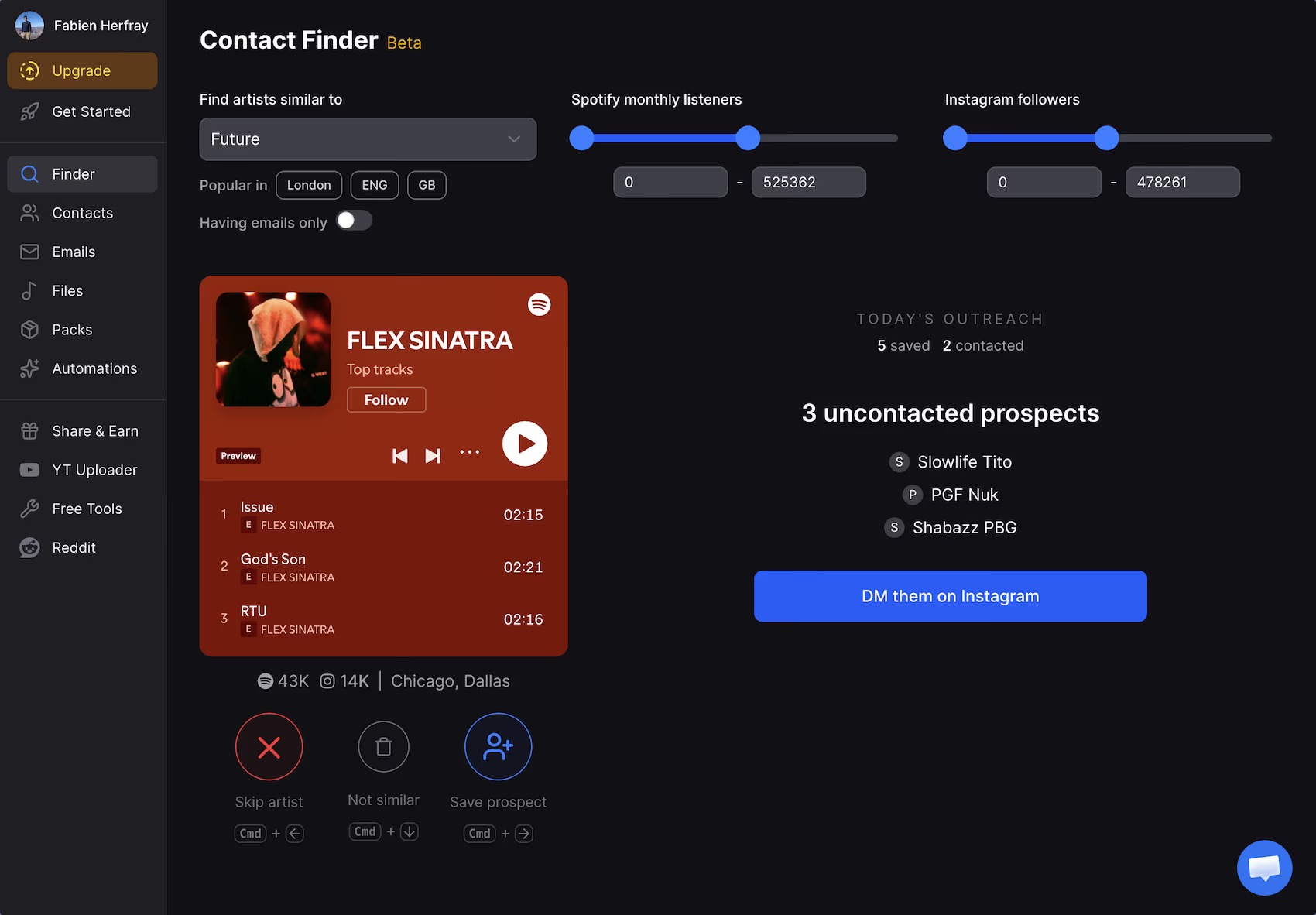
Find artists that fit you
Prospects matched to your sound, size, and location.
Turn them into connections
Personalized DMs, follow-ups, and guided outreach.
Keep relationships alive
Automatic packs by email and reminders to reconnect.
Loved by 3497 producers
 TapDaddyBeats1M+ Streams
 Churass MusicMulti-platinum Publisher
 BE-TWIIN Beats50M+ Streams, 1000+ Artists
 Prodbymeadow1K+ Syncs, 15M+ Streams
 Royal808Platinum Producer
 fizzo4911M+ Streams
 LLoke Made3x Billboard Charting
 SIGHOST8M+ BeatStars Plays
 LitKidBeats18M+ YouTube Views
- TapDaddyBeats1M+ Streams
- Churass MusicMulti-platinum Publisher
- BE-TWIIN Beats50M+ Streams, 1000+ Artists
- Prodbymeadow1K+ Syncs, 15M+ Streams
- Royal808Platinum Producer
- fizzo4911M+ Streams
- LLoke Made3x Billboard Charting
- SIGHOST8M+ BeatStars Plays
- LitKidBeats18M+ YouTube Views